Fitness coaches often find themselves trapped in a cycle of trading time for money, an unsustainable model that caps income and leads to burnout. This challenge arises because they are selling hours, not scalable systems. The typical $6K monthly revenue cap for many 1-on-1 coaches, supporting around 25-30 clients at $200-250/month, highlights this ceiling. Traditional online solutions like recorded courses or generic membership sites frequently fail for fitness professionals due to a lack of personalized accountability. A paid group funnel model offers a breakthrough, allowing coaches to scale their income significantly without increasing their working hours.
Why Traditional Fitness Coaching Models Don’t Scale
The mathematical reality of 1-on-1 coaching creates an inherent income ceiling. Coaches are limited by the number of hours they can physically work, making burnout an inevitable outcome for those striving for higher earnings. The median annual wage for fitness trainers and instructors was $46,180 in May 2024, reflecting the constraints of this model according to the Bureau of Labor Statistics. Online courses, while seemingly scalable, suffer from a significant problem: low completion rates. Platforms using machine learning for adaptive workout plans achieve only 25% higher completion rates for multi-week programs, suggesting that even advanced tech struggles with user adherence per Technavio market analysis. Without real-time accountability and interaction, static content often leads to zero results and refund requests. Free Facebook groups offer high engagement but zero revenue, forcing coaches onto a constant content creation treadmill without direct monetization. The “hybrid trap” of attempting to manage multiple models simultaneously usually results in scaling nothing effectively.

The Paid Group Funnel Model: Architecture and Economics
A paid group funnel is a structured system where fitness coaches deliver personalized guidance and accountability to multiple clients simultaneously within a cohort-based community. This model transforms a coach’s income potential by shifting from selling individual hours to offering a scalable, results-driven experience. The economic shift is substantial: a coach can manage 50-100 members at $99-149/month, generating significantly more revenue than 25 clients at $200/month as noted by gym profitability analysts. Automated 1-on-1 private delivery is central to this model, allowing coaches to provide daily workouts, guidance, and progress tracking at scale. This automation makes each client feel like they are receiving personalized attention without the coach needing to individually message each one. The coach’s role evolves from a constant doer into a designer of engaging programs and a facilitator of community, empowering them to monetize their expertise more effectively.
Case Study: Alex’s Burnout at $6K MRR
Alex, a dedicated fitness coach, found himself capped at $6,000 in monthly recurring revenue (MRR). This income came from 25 1-on-1 clients, each paying $240/month. Alex was spending over 30 hours per week delivering personalized sessions and constantly responding to client questions. This demanding schedule left no time for marketing, business growth, or even personal life, leading to significant burnout. The reality became clear: the traditional 1-on-1 model would never provide the financial freedom or personal time Alex desired. Burnout affects roughly one-third (32-33%) of trainers, highlighting a widespread industry challenge per industry studies cited in 2026 analyses.
Case Study: Alex’s Pivot to the Paid Group Funnel
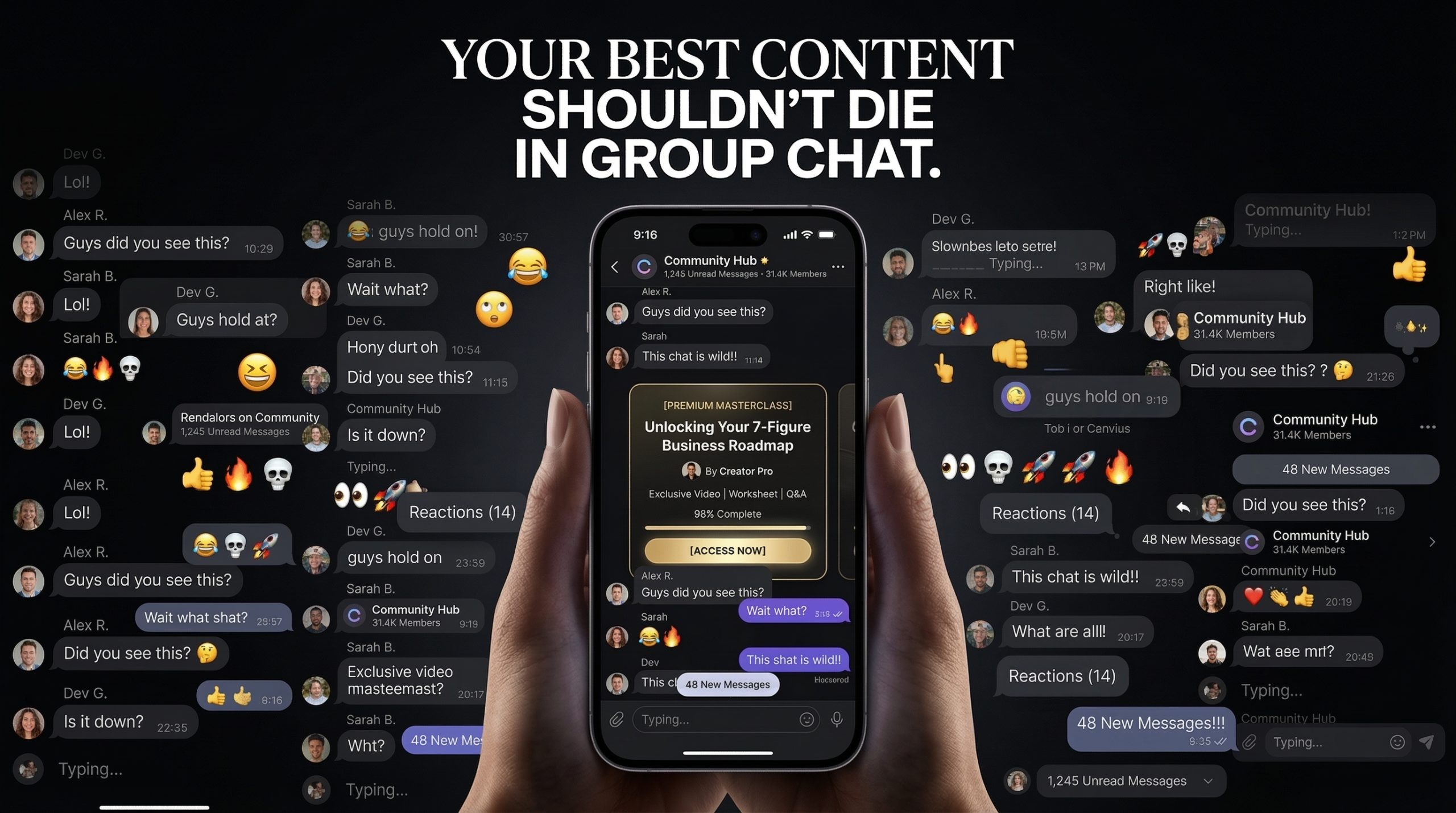
Faced with burnout, Alex made a strategic decision to pivot. Alex launched a paid accountability group on WhatsApp, priced at an accessible $99/month. The offer included daily workouts, basic nutrition guidance, and group accountability, crucially, without any direct 1-on-1 calls. Alex successfully retained 15 top-tier 1-on-1 clients while simultaneously building the new group to 70 members. The initial challenge was maintaining high accountability for 70 people without content getting lost in overwhelming group chats. Messaging apps like WhatsApp, while popular, can be noisy and fragmented for scaling fitness communities according to Vibefam.

Case Study: Alex’s Secret Weapon – CommuniPass for Automated 1-on-1 Delivery
The critical hurdle of scaling personalized delivery was solved by integrating CommuniPass. With CommuniPass, Alex records a single daily video or voice note, then schedules it within the system. CommuniPass then delivers this content directly to each member’s private WhatsApp or Telegram DM, creating the feeling of a personalized 1-on-1 coaching experience. This system effectively handles Stripe billing, automatically removing non-paying members and managing the entire member lifecycle. Alex’s new reality is now $10,530 MRR, combining revenue from 15 retained 1-on-1 clients and 70 group members. The time commitment has drastically reduced to 15-20 hours per week, thanks to the automated 1-on-1 content delivery system.
The 90-Day Implementation Roadmap
Transitioning to a paid group funnel requires a structured approach to ensure success and scalability. This roadmap provides a clear path for fitness coaches to establish and grow their new model.
- Month 1: Design and Setup. Focus on designing your initial challenge, setting up your CommuniPass account, and creating a core library of content (e.g., workout videos, nutrition guides). Define your paid group offer, pricing, and positioning, aiming for a price point around $99-$149/month as suggested by gym pricing strategy experts.
- Month 2: Launch and Facilitation. Launch your first challenge, converting participants into your ongoing paid group. Establish clear rhythms for content delivery, feedback loops, and community engagement. This period is crucial for refining your facilitation style and gathering initial member feedback.
- Month 3: Refine and Systematize. Based on feedback from your first cohort, refine your content and processes. Launch a second group or challenge, aiming for consistent growth. Systematize operations to reduce manual effort further, leveraging CommuniPass’s automation features to manage member lifecycle and content delivery.
With consistent execution, fitness coaches can realistically reach $10K MRR within 4-6 months using this model.
Real Numbers: The $6K to $10K MRR Breakdown
The shift from a time-intensive 1-on-1 model to a scalable paid group funnel significantly boosts revenue and reduces workload. Starting with 25 1-on-1 clients at $240/month generates $6,000 MRR, but demands over 30 hours per week in delivery. This model is capped by the coach’s available hours. By transitioning to a hybrid model, a coach can retain 15 premium 1-on-1 clients, generating $3,600 MRR. Simultaneously, launching two paid groups of 35 members each at $99/month brings in an additional $6,930 MRR. This combined approach results in $10,530 MRR. The crucial difference is that the time investment drops to 15-20 hours per week, thanks to automated 1-on-1 content delivery handling routine interactions. This efficiency is paramount, as AI tools can save coaches 6-8 hours weekly on repetitive tasks according to Trainerize’s 2026 report. This frees up time to focus on strategic growth, potentially scaling to $20K MRR by adding a premium tier, corporate partnerships, or a certification program.
Common Objections and How to Overcome Them
Many fitness coaches harbor reservations about transitioning from traditional 1-on-1 coaching to a group model. Addressing these objections directly reveals the advantages of the paid group funnel.
‘My clients need personalized attention’
Automated 1-on-1 delivery, facilitated by platforms like CommuniPass, combined with group accountability, often yields superior results. While one daily video or voice note is created once, its delivery to each member’s private DM creates a highly personalized experience. This approach provides consistent, expert guidance that feels bespoke, often leading to better adherence than intermittent 1-on-1 sessions.
‘I don’t want to lose my 1-on-1 clients’
A hybrid retention strategy is highly effective. Identify your top 10-15 most engaged 1-on-1 clients who truly value the premium, direct access, and offer them a higher-tier package. These clients appreciate the continued personalized touch, while the group model allows you to serve a broader audience efficiently. This approach ensures you retain your highest-value clients while scaling your overall income.
‘I’m not tech-savvy enough’
The minimal tech stack required for this model is surprisingly simple. Platforms like CommuniPass are designed for ease of use, handling billing, member management, and content delivery with intuitive interfaces. Setup involves recording content, scheduling it, and letting the system distribute it. Many coaches find the learning curve minimal, especially with dedicated support.
‘My niche is too specialized’
Paid groups can thrive across all fitness specializations, from pre/post-natal to strength training for specific sports. The core principle of shared goals and consistent accountability transcends niche. In fact, a specialized niche can foster a stronger, more cohesive group dynamic, as members share very specific challenges and triumphs.

Key Takeaways
- The paid group funnel model effectively breaks the income ceiling imposed by traditional 1-on-1 fitness coaching.
- Automated 1-on-1 content delivery, through platforms like CommuniPass, provides personalized guidance at scale without increasing a coach’s working hours.
- A hybrid approach, retaining top 1-on-1 clients while growing paid groups, allows for a smooth and profitable transition.
- Coaches can realistically achieve $10K MRR within 4-6 months by leveraging this scalable model.
- Paid groups offer higher accountability and community engagement compared to static online courses.
Conclusion: From Time Trap to Scalable System
The traditional fitness coaching model, heavily reliant on 1-on-1 interactions, inevitably leads to an income ceiling and burnout. This time-for-money trap prevents many talented coaches from realizing their full earning potential and impact. The emergence of the paid group funnel, specifically when powered by automated 1-on-1 content delivery, offers a powerful solution. By shifting focus from selling individual hours to creating interactive, scalable experiences, fitness coaches can significantly increase their monthly recurring revenue while drastically reducing their weekly workload. Platforms like CommuniPass are instrumental in amplifying a coach’s expertise and availability, delivering a personalized touch to many without sacrificing quality. The future of fitness coaching lies in these integrated, interactive experiences that prioritize engagement and outcomes over static content.

Fitness Coaching Business Models Compared: Revenue vs Fulfillment Effort
This table compares four common fitness coaching models across key business metrics, showing why the paid group funnel with automated 1-on-1 delivery offers the best balance of income, scalability, and time freedom. It helps coaches understand the trade-offs of each approach and why traditional models create burnout.
| Business Model | Monthly Revenue Potential | Fulfillment Effort (Hours/Week) | Client Accountability Level |
|---|---|---|---|
| 1-on-1 Coaching Only | $4K – $8K | 30-40+ | High (direct, but limited by coach’s time) |
| Static PDF/Course Sales | Variable (low conversion/completion) | 5-10 (initial creation) | Very Low (5-15% completion rates) |
| Free Facebook Group | $0 (indirect revenue only) | 10-20 (content creation/moderation) | Medium (peer support, but no paid commitment) |
| Native Paid Group + 1-on-1 Automated Delivery (CommuniPass) | $10K – $20K+ | 15-20 | High (structured, personalized delivery + group support) |
Ready to Break Your Income Ceiling?
Stop trading your hours for dollars and ditch the static PDFs. Build a high-retention paid accountability group on WhatsApp or Telegram.
Frequently Asked Questions
How much can fitness coaches realistically make with paid group coaching?
Fitness coaches can realistically make $10,000 to $20,000+ MRR with paid group coaching. This is achieved by serving 50-100 members at price points ranging from $99 to $249 per month, with earnings influenced by niche specialization and audience size.
What is a paid group funnel and how does it work for fitness coaching?
A paid group funnel involves moving prospects from an initial paid challenge (e.g., 21-day program for $27-47) into an ongoing, higher-priced paid group subscription. This model provides structured cohorts with automated 1-on-1 content delivery and community accountability, guiding members from a short-term commitment to long-term engagement.
Do I need to stop doing 1-on-1 coaching to start a paid group?
No, you do not need to stop 1-on-1 coaching entirely; a hybrid approach is recommended. You can retain your top 10-15 premium 1-on-1 clients while simultaneously building your paid group revenue, creating a more diversified and scalable income stream.
How do I scale without losing the personal 1-on-1 touch?
You scale without losing the personal touch by using a backend tool like CommuniPass to schedule your daily guidance. This system delivers your recorded content (e.g., video or voice notes) directly to each client’s private DM, making it feel like personalized 1-on-1 coaching without requiring individual calls or messages from you.
What’s the difference between a paid group and a membership site for fitness?
A paid group offers interactive, cohort-based accountability with clear outcomes and a strong sense of community, often leveraging automated 1-on-1 content delivery. A membership site typically provides static, on-demand content with less direct interaction or personalized accountability, leading to lower engagement and completion rates.
How long does it take to go from $6K to $10K MRR with this model?
It typically takes 4-6 months to go from $6K to $10K MRR with consistent execution. This timeline includes designing challenges, setting up systems like CommuniPass, launching initial cohorts, and refining the offering based on member feedback.
What platforms work best for running paid fitness groups?
WhatsApp and Telegram are excellent choices for running paid fitness groups due to their widespread use and direct messaging capabilities. Dedicated platforms like CommuniPass integrate with these messaging apps, handling subscriptions, automated content delivery, and member management seamlessly.
Will my clients get the same results in a group as they do with 1-on-1 coaching?
Clients can often achieve comparable, if not better, results in a well-structured paid group due to enhanced peer support, consistent automated 1-on-1 guidance, and the motivational power of community. The hybrid approach ensures those needing intensive 1-on-1 support still receive it, while the group environment drives collective progress.
How do I price my paid fitness group without undervaluing my expertise?
Price your paid fitness group based on the value and outcomes delivered, with common ranges from $99 to $249 per month. You can offer tiered pricing, with higher tiers including additional benefits like group calls or monthly check-ins, to reflect greater access and personalization.
What should I include in a fitness challenge that converts to paid groups?
A fitness challenge that converts to paid groups should be 21-30 days long, include daily workouts, nutrition guidance, and foster strong community accountability. Price it affordably (e.g., $27-47) and aim for a 30-40% conversion rate of challenge participants into your ongoing paid group.
Key Terms Glossary
Paid Group Funnel: A strategic marketing and sales process that guides prospects from a short-term, low-cost challenge into a recurring, higher-priced paid group membership.
MRR (Monthly Recurring Revenue): The predictable total revenue generated from all active subscriptions or memberships in a given month. Explore monetize with paid challenges.
Automated 1-on-1 Delivery: A system where a coach creates content once, and it is automatically delivered to individual clients’ private messages, simulating personalized coaching at scale. Explore monetization strategies for fitness coaches.
Hybrid Coaching Model: A business approach that combines elements of 1-on-1 coaching with group coaching or online programs to maximize revenue and scalability. Explore fitness influencer monetization.
CommuniPass: A platform designed to help experts and coaches monetize their expertise through paid groups and challenges, automating client management and content delivery on popular messaging apps. Explore coaching income ceiling.
Income Ceiling: The maximum earning potential a coach can achieve within a specific business model, often limited by time or client capacity. Explore launch a paid challenge.
Cohort-Based Learning: A structured educational or coaching model where groups of participants start and progress through a program together, fostering community and peer support.