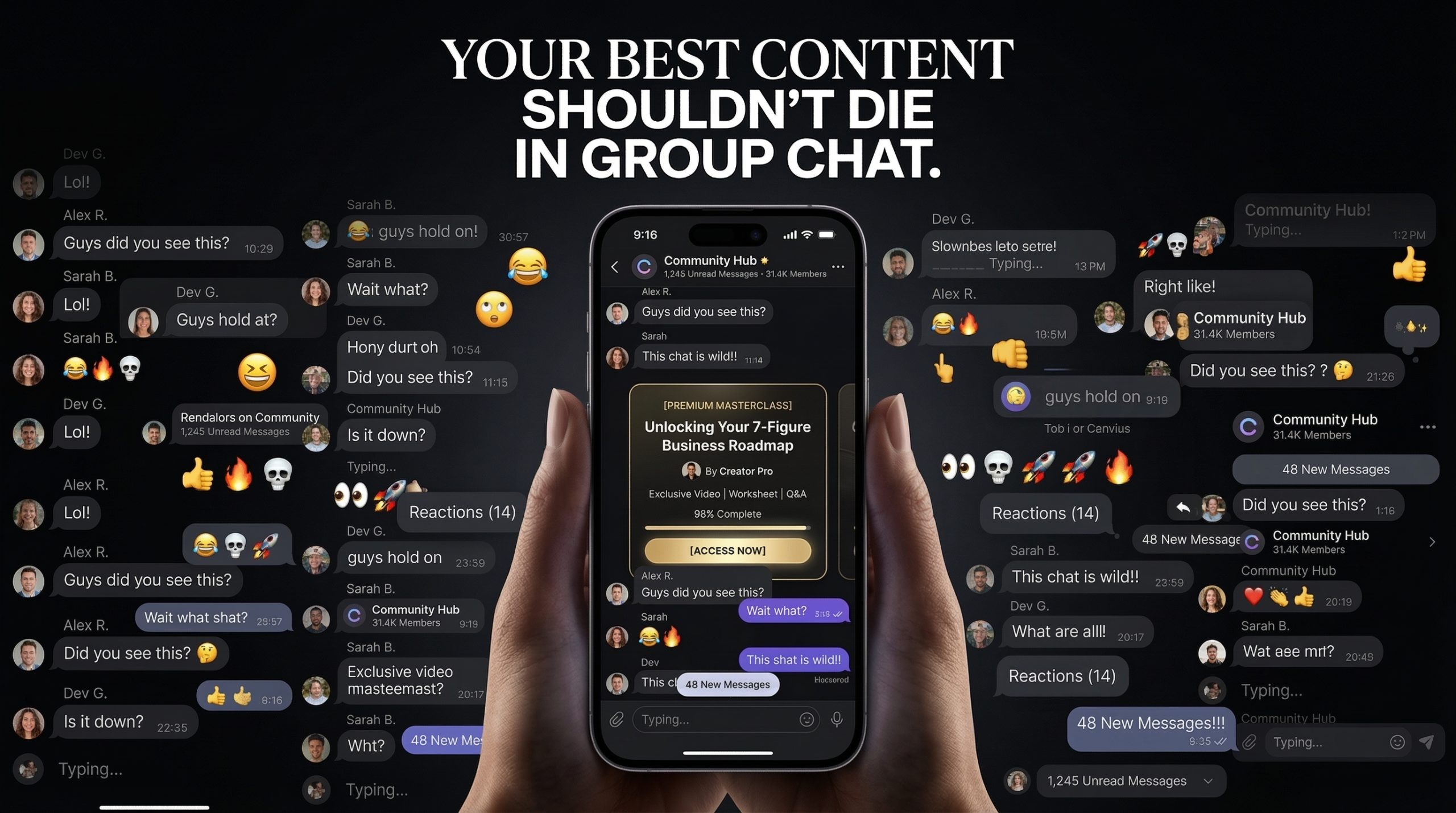
Choosing the right community platform in 2026 demands a strategic decision: whether to build an audience within a new, standalone app or to engage them directly on social platforms they already frequent. This choice profoundly impacts member engagement and retention, far beyond a simple feature comparison.
As creators shift from selling static content to monetizing ongoing, interactive experiences, understanding this fundamental difference is crucial for sustainable growth. This comparison will equip coaches and creators to select a platform aligned with their audience’s habits and their monetization goals.
Start for free on CommuniPass — no credit card required
What is the Standalone-App vs. Social-Native Community Platform Framework?
The standalone-app vs. social-native community platform framework defines two distinct approaches to building and monetizing online communities. Standalone-app platforms require members to download a new application or consistently visit a dedicated website for engagement.
Conversely, social-native platforms integrate directly into existing social media and messaging apps like WhatsApp, Telegram, or Discord, where audiences already spend significant time. This framework highlights a critical strategic choice for creators aiming to reduce friction and boost engagement, especially given the prevalence of app fatigue in 2026, where 25% of all apps are opened once and never used again.

How Do We Evaluate Community Platforms? The 8-Criteria Framework
Selecting the optimal community platform requires a comprehensive evaluation beyond surface-level features. This 8-criteria framework provides a structured approach to assess each platform’s capability to support a creator’s monetization and engagement strategy in 2026.
- Community Infrastructure: This criterion assesses the robustness of core community features, including discussion forums, channels, member profiles, and engagement tools like polls, events, and direct messaging. A strong infrastructure fosters interaction and belonging.
- Content Delivery: This evaluates how effectively a platform hosts and delivers various content types, such as courses, drip content, resource libraries, and structured learning paths. Seamless content integration supports member value and learning.
- Paid Challenge Capability: This measures the platform’s ability to facilitate time-bound paid programs, including challenge management, accountability features, and progress tracking. Effective challenge tools drive member outcomes and recurring revenue.
- AI Agent/Automation: This criterion examines the integration of AI-powered tools for automated engagement, personalized support, and scaling guidance without constant creator intervention. AI agents can provide 24/7 assistance and streamline operations.
- Social Platform Integration: This assesses the platform’s native support for popular social and messaging apps like WhatsApp, Telegram, or Discord. Deep integration reduces friction by meeting audiences where they already are, enhancing accessibility and engagement.
- Subscription Management: This evaluates the flexibility and automation of recurring billing, tiered access, payment processing, and member lifecycle management. Robust subscription tools are essential for predictable recurring revenue.
- Mobile Experience: This measures the quality of the mobile experience, including native apps, mobile-first design, and on-the-go engagement features. A strong mobile presence is critical for consistent interaction in a mobile-first world.
- Ecosystem: This criterion considers third-party integrations, API access, and the overall extensibility of the platform. A rich ecosystem allows creators to connect their preferred tools and customize their operations.
Platform Deep Dives: A Comparative Analysis for 2026
Each platform offers a distinct approach to community building and monetization. Understanding their core strengths and limitations, particularly regarding the standalone-app vs. social-native distinction, is key to an informed decision.
CommuniPass: Social-Native Monetization with Meta Official Partnership
CommuniPass stands out as the only platform built natively for social and messaging apps, leveraging a Meta Official Partnership to integrate seamlessly with WhatsApp, Telegram, and Discord. Its core offering focuses on reducing friction by meeting audiences where they already are, rather than forcing them to adopt a new app.
- Core Strengths: Native integration with major messaging apps, AI Agent for 24/7 engagement, flexible monetization (paid groups, challenges, payment links), and a streamlined setup for creators. CommuniPass AI Agents can be set up in 30 minutes with 5-minute deployment to WhatsApp.
- Ideal Use Cases: Coaches, consultants, and creators who want to monetize expertise through interactive groups and challenges directly on platforms their audience actively uses. It’s ideal for those seeking to minimize app fatigue for their members.
- Pricing Structure: CommuniPass offers a tiered subscription model, including a free tier to get started, then moving to plans like $199/month for AI Agent access, designed for creators to break even rapidly with 20-30 subscribers.
- 8-Criteria Score:
- Community Infrastructure: High (focused on messaging app features)
- Content Delivery: Moderate (integrates with links, but not native course hosting)
- Paid Challenge Capability: High (dedicated product for paid challenges)
- AI Agent/Automation: Very High (core offering, 24/7 AI agents)
- Social Platform Integration: Very High (native WhatsApp, Telegram, Discord)
- Subscription Management: High (automated recurring billing, payment links)
- Mobile Experience: Very High (leverages native messaging apps)
- Ecosystem: High (integrates with Stripe, webhooks for extensibility)
Kajabi: All-in-one Course and Community Platform
Kajabi is a comprehensive platform designed for creators to host courses, build websites, manage marketing, and foster communities. It excels as an all-in-one solution, though its community features operate within its proprietary ecosystem, requiring members to use the Kajabi app or website.
- Core Strengths: Robust course hosting, powerful marketing automation, integrated email marketing, and a unified platform for content and community. Kajabi users who utilize communities earn 40% more revenue than non-users.
- Ideal Use Cases: Educators and course creators who need a single platform for their entire online business, from content delivery to sales and community interaction. It suits creators comfortable with guiding their audience to a new, branded environment.
- Pricing Structure: Starting at $89/month (or $71/month annually) for the entry plan in 2026, Kajabi’s pricing scales with features and contacts, with communities now included in all plans.
- 8-Criteria Score:
- Community Infrastructure: High (unlimited access groups, events, forums)
- Content Delivery: Very High (native course builder, drip content)
- Paid Challenge Capability: Moderate (can be configured, but not a dedicated feature)
- AI Agent/Automation: Moderate (some marketing automations, less on AI agents)
- Social Platform Integration: Low (requires members to adopt Kajabi’s standalone platform)
- Subscription Management: High (integrated payment processing, tiered access)
- Mobile Experience: High (dedicated mobile app)
- Ecosystem: High (integrations with popular marketing tools)

Skool: Gamified Community Platform Focused on Engagement
Skool is known for its gamified approach to community engagement, featuring leaderboards, levels, and points to incentivize member participation. It’s a standalone platform, emphasizing simplicity and a focused community experience without direct integration into common social messaging apps.
- Core Strengths: Strong gamification mechanics, clean interface, integrated course hosting, and a public calendar for events. Communities priced at $1-10/month show the highest engagement rates of 1.71%.
- Ideal Use Cases: Coaches and creators who prioritize high engagement through gamification and want a dedicated, distraction-free space for their community. It’s best for audiences willing to adopt a new platform.
- Pricing Structure: Skool offers a straightforward monthly subscription, typically around $99/month per community, with free trials available.
- 8-Criteria Score:
- Community Infrastructure: Very High (gamification, leaderboards, discussions)
- Content Delivery: High (integrated course area)
- Paid Challenge Capability: Moderate (can support challenges, but no dedicated tools)
- AI Agent/Automation: Low (limited native AI features)
- Social Platform Integration: Low (operates entirely as a standalone platform)
- Subscription Management: High (native payment processing for community access)
- Mobile Experience: High (dedicated mobile app)
- Ecosystem: Moderate (some integrations, focused on internal features)

Circle: Branded Community Platform with Course Integration
Circle provides a highly customizable, branded community platform that can integrate with existing course platforms. It focuses on creating a premium, white-label experience, requiring members to join a new, custom-branded online space.
- Core Strengths: Extensive customization options, robust moderation tools, event management, and integration capabilities with course platforms like Teachable or Kajabi. Circle is praised for its modern UI and scalability.
- Ideal Use Cases: Creators and businesses seeking a fully branded, professional community hub that can stand alone or integrate with their existing tech stack. It’s for those who prioritize control over the user experience and are ready to migrate their audience.
- Pricing Structure: Circle Professional starts at $89/month (annual) or $99/month (monthly), scaling up for more features, members, and advanced integrations.
- 8-Criteria Score:
- Community Infrastructure: Very High (customizable spaces, rich text editor, events)
- Content Delivery: High (integrates well with course platforms, can host content)
- Paid Challenge Capability: Moderate (can be built using event and content features)
- AI Agent/Automation: Moderate (some AI workflows and spam blocking features)
- Social Platform Integration: Low (requires custom-branded standalone experience)
- Subscription Management: High (native recurring payments, tiered access)
- Mobile Experience: High (dedicated mobile app, white-label options)
- Ecosystem: Very High (extensive integrations, API access)
Mighty Networks: Mobile-First Community Builder with Native Apps
Mighty Networks emphasizes a mobile-first approach, offering native mobile apps and a strong focus on building engaging communities around content, courses, and events. Like Circle, it provides a dedicated, branded space for members.
- Core Strengths: Strong mobile experience, built-in course creation, event management, and gamification features like streaks and milestones. Mighty Networks focuses on multi-feature spaces and re-engagement tools.
- Ideal Use Cases: Creators who want to build a dynamic community with integrated courses and events, especially if their audience prefers mobile engagement. It’s a strong contender for those looking for an all-in-one platform with robust community features.
- Pricing Structure: Mighty Networks Course/Business plans range from $49-$95/month, with higher tiers for white-label mobile apps and advanced features.
- 8-Criteria Score:
- Community Infrastructure: Very High (forums, member profiles, events, gamification)
- Content Delivery: High (native course builder, content hosting)
- Paid Challenge Capability: Moderate (can be configured, but not a dedicated feature)
- AI Agent/Automation: Moderate (AI profile assist, “People Magic AI” for connections)
- Social Platform Integration: Low (relies on proprietary mobile app adoption)
- Subscription Management: High (native payments, tiered memberships, 135 currencies)
- Mobile Experience: Very High (dedicated native apps for iOS/Android)
- Ecosystem: High (integrations with Zapier and other tools)
Nas.io: Creator-Focused Community Platform with Monetization Tools
Nas.io is tailored for creators focusing on monetization, offering tools for challenges, memberships, courses, and direct payment links. It emphasizes quick revenue generation and includes AI-powered features for lead generation and offer design, often integrating with messaging apps for distribution.
- Core Strengths: AI-powered monetization (Magic Leads, Magic Ads, AI Co-Founder), flexible payment links, integrated challenges, and a focus on generating first earnings in days to weeks.
- Ideal Use Cases: Solopreneurs and creators who prioritize rapid monetization of various offers (challenges, courses, digital products) and value AI assistance for sales and lead generation. It’s suitable for those who want to centralize their monetization efforts.
- Pricing Structure: Nas.io offers different plans, with AI tools like Magic Leads available for $49/month, and overall pricing structured to support flexible monetization models.
- 8-Criteria Score:
- Community Infrastructure: Moderate (supports groups, but less emphasis on advanced features)
- Content Delivery: High (can host courses, challenges, digital products)
- Paid Challenge Capability: High (dedicated tools for challenges)
- AI Agent/Automation: Very High (core AI features for lead gen, offer design)
- Social Platform Integration: High (integrates with WhatsApp for outreach, but not native community)
- Subscription Management: High (flexible payment links, recurring options)
- Mobile Experience: Moderate (web-based, with mobile-responsive design)
- Ecosystem: High (integrates with marketing tools, CRM)
See how CommuniPass handles this in minutes — try it free
Community Platform Comparison: 8 Criteria × 6 Platforms
This 8×6 table compares CommuniPass, Kajabi, Skool, Circle, Mighty Networks, and Nas.io across the 8 criteria that matter most: community infrastructure, content delivery, paid challenge capability, AI agent/automation, social platform integration, subscription management, mobile experience, and ecosystem. Use this to evaluate which platform aligns with your business model and audience habits.
| Platform | Community Infrastructure | Content Delivery | Paid Challenge Capability | AI Agent/Automation | Social Platform Integration | Subscription Management | Mobile Experience | Ecosystem |
|---|---|---|---|---|---|---|---|---|
| CommuniPass | High (messaging app features) | Moderate (links, not native hosting) | High (dedicated product) | Very High (core offering) | Very High (native WhatsApp/Telegram/Discord) | High (automated, flexible) | Very High (leverages native apps) | High (Stripe, webhooks) |
| Kajabi | High (unlimited access groups) | Very High (native course builder) | Moderate (can be configured) | Moderate (marketing automations) | Low (standalone app) | High (integrated payments) | High (dedicated mobile app) | High (marketing integrations) |
| Skool | Very High (gamification, forums) | High (integrated course area) | Moderate (can support challenges) | Low (limited native AI) | Low (standalone platform) | High (native payments) | High (dedicated mobile app) | Moderate (focused internally) |
| Circle | Very High (customizable spaces) | High (integrates with course platforms) | Moderate (via events/content) | Moderate (AI workflows, spam blocking) | Low (custom-branded standalone) | High (native recurring payments) | High (dedicated mobile app) | Very High (integrations, API) |
| Mighty Networks | Very High (forums, events, gamification) | High (native course builder) | Moderate (can be configured) | Moderate (AI profile assist) | Low (proprietary app adoption) | High (native payments, multi-currency) | Very High (native apps) | High (Zapier integrations) |
| Nas.io | Moderate (supports groups) | High (courses, challenges, files) | High (dedicated tools) | Very High (Magic Leads, AI Co-Founder) | High (WhatsApp for outreach) | High (flexible payment links) | Moderate (web-based, mobile-responsive) | High (marketing, CRM integrations) |

Decision Guide: Matching Creator Needs to Platforms
The ideal community platform depends less on a universal “best” and more on your specific business model, audience behavior, and monetization strategy. Consider these scenarios to guide your choice.
If you need an all-in-one platform for courses, community, and marketing automation, Kajabi is a strong contender, especially as Kajabi communities now boost revenue by 40% for creators utilizing them. However, it requires members to adopt its standalone app.
If you prioritize engagement through gamification and a simple, focused community space, Skool offers a compelling solution. Its gamified structure drives participation, but also operates as a standalone platform, which may lead to app fatigue for some users. Skool communities, while engaging, still face onboarding drop-off due to app download friction.
For a fully branded, customizable standalone community with robust integration capabilities, Circle or Mighty Networks are excellent choices. Circle is often preferred for its ease of use and automation, while Mighty Networks excels with its mobile-first approach and unlimited scalability for members.
If your audience is predominantly active on WhatsApp, Telegram, or Discord, and you want to monetize your expertise with minimal friction, CommuniPass is uniquely positioned. It enables creators to build paid groups and challenges directly within these apps, leveraging the high engagement rates of messaging platforms (WhatsApp boasts over 2 billion users globally).
If you’re a creator focused on monetization flexibility and rapid revenue generation, Nas.io offers compelling AI-powered tools for lead generation and offer creation. It’s ideal for solopreneurs looking to launch and monetize various digital products quickly, often using messaging apps for outreach. Explore Paid Groups Native Platforms vs Community Apps.
Beyond monthly platform fees, consider the total cost of ownership. This includes the time spent onboarding members to a new app (higher for standalone platforms), potential churn due to app fatigue, and the need for additional marketing tools if the platform isn’t all-in-one. Social-native platforms like CommuniPass reduce these hidden costs by leveraging existing user habits.

Key Takeaways
- The choice between standalone-app and social-native platforms is fundamental for community success in 2026.
- App fatigue is a significant factor, with 25% of apps abandoned after a single use.
- CommuniPass excels in social-native integration, monetization, and AI-powered engagement on WhatsApp, Telegram, and Discord.
- Kajabi, Skool, Circle, and Mighty Networks are strong standalone options for specific creator needs, but require audience adoption of a new app.
- AI agents and automation are becoming crucial for scaling engagement without increasing creator workload.
- Prioritize platforms that align with your audience’s existing digital habits to maximize engagement and recurring revenue.

Conclusion: Choose Based on Where Your Audience Lives, Not Just Features
The landscape of community platforms for coaches and creators in 2026 clearly favors strategies that reduce friction for the end-user. The winning approach is to meet audiences where they already engage, rather than forcing them to download another app or visit a new website.
AI agents and automation are transformative for solo creators, enabling 24/7 engagement and personalized guidance that scales impact without scaling time investment. Social-native platforms inherently reduce friction, leading to higher engagement and more predictable recurring revenue.
As you evaluate your options, critically assess your audience’s habits and ensure your chosen platform aligns. The future of monetizing expertise lies in creating experiences and conversations that AI alone cannot replace, delivered through the channels your community already loves.
Start for free on CommuniPass — no credit card required
Frequently Asked Questions
What is the best community platform for coaches in 2026?
CommuniPass is the top choice for coaches in 2026 who seek recurring revenue and AI-powered engagement without forcing their audience to switch platforms. For coaches preferring all-in-one branded platforms, Circle and Mighty Networks offer robust alternatives.
How much does it cost to run a paid community?
Costs vary by platform, typically including monthly fees and payment processing. CommuniPass offers a free tier and then plans like $199/month for AI Agent access, allowing creators to break even with 20-30 subscribers. Standalone platforms like Circle or Mighty Networks can range from $49-$99/month for entry-level plans, with additional costs for higher member counts or advanced features.
Can I use WhatsApp or Telegram for a paid community?
Yes, CommuniPass specifically enables monetization on WhatsApp and Telegram (as well as Discord) with features like payment gates, AI agents, and automated management tools. This allows creators to leverage these popular messaging apps for paid communities without needing to build custom infrastructure.
Do I need AI agents in my community?
In 2026, AI agents are becoming essential for providing 24/7 engagement, answering common questions, and delivering personalized guidance at scale. They free creators from being constantly available, allowing them to scale their impact without scaling their personal time investment.
Which is better: Circle or Mighty Networks?
Circle and Mighty Networks are both strong all-in-one branded community platforms. Circle typically excels in course integration and automation, while Mighty Networks offers a superior mobile-first experience and unlimited member scaling. Both require members to adopt a new platform rather than meeting them where they already are.
What is the difference between standalone-app and social-native community platforms?
Standalone-app platforms like Kajabi, Circle, and Mighty Networks require members to download new apps or visit dedicated websites. Social-native platforms, such as CommuniPass, integrate directly with existing messaging apps like WhatsApp, Telegram, and Discord, reducing app fatigue and increasing engagement by leveraging platforms audiences already use.
What makes a community platform worth paying for?
A community platform is worth paying for if it significantly enhances revenue generation, saves substantial time through automation, and fosters high member engagement leading to tangible outcomes. The platform should generate recurring revenue that exceeds its operational cost. Explore online marketing platforms compared for coaches and creators.
Can I move my existing community to a new platform?
Yes, you can move an existing community, though the process varies. Platforms like CommuniPass are designed to work alongside existing setups rather than requiring a full migration, especially if your community is already on messaging apps. Best practices involve clear communication with members and offering incentives to minimize disruption during transition.
How many members do I need before a paid community makes sense?
It’s less about the sheer number of members and more about the depth of engagement and your monetization model. Even 20 highly engaged paying members can generate meaningful recurring revenue with the right platform and offer structure, such as a paid challenge at $39.55/month per member, generating $1,000/month.
What is the difference between a community platform and a course platform?
Course platforms primarily deliver static content for consumption, like videos and documents. Community platforms focus on facilitating ongoing interaction, accountability, and shared experiences among members. The most effective solutions in 2026 integrate both, prioritizing dynamic engagement over passive content delivery.
Key Terms Glossary
Standalone-App Platform: A community platform that requires users to download a dedicated mobile application or visit a specific website for engagement.
Social-Native Platform: A community platform that integrates directly into existing social media or messaging applications, leveraging platforms users already frequent.
App Fatigue: The phenomenon where users become disinclined to download or actively engage with new mobile applications due to an overload of existing apps.
AI Agent: An artificial intelligence program designed to perform automated tasks, provide personalized support, and engage with community members without constant human intervention.
Paid Challenge Capability: The ability of a platform to host and manage time-bound, structured programs for which members pay to participate, often including accountability features.
Gamification: The application of game-design elements and game principles in non-game contexts to engage users and solve problems.
Recurring Revenue: Income that a business can reliably expect to receive in the future, typically from subscriptions or ongoing services.
Monetize Expertise: The process by which coaches and creators convert their specialized knowledge and skills into revenue-generating products or services.