Many LinkedIn strategists, B2B consultants, and executive coaches find themselves trapped in a cycle of trading hours for dollars. They offer valuable one-time services, but struggle to scale their impact or income beyond a hard ceiling. This case study explores how a strategic shift from individual audits to a high-engagement 7-day challenge transformed one expert’s business.
The Sprint-to-Premium model is a strategic framework that leverages short, intensive challenges to build trust, deliver immediate results, and seamlessly convert participants into high-ticket coaching or consulting clients. It shifts the focus from selling static information or one-off services to creating dynamic, outcome-driven experiences that naturally lead to premium offers.
The Audit Trap: Why Selling Your Time in Small Increments Prevents You from Building a Real Business
Meet Sarah Chen, a highly skilled LinkedIn expert who found herself stuck in the familiar $500 profile audit cycle. To increase her income, Sarah had to sell more audits, which meant more Zoom calls, more manual work, and ultimately, hitting a hard income ceiling. This problem echoes a broader trend where 47.6% of North American firms reported increased net revenues in 2024 by adopting advanced revenue management strategies, highlighting the need for consultants to move beyond transactional models.
This transactional model, often seen in the consultancy death spiral, exchanges hours for dollars with no clear path to scale. When Sarah attempted to break free by selling a $297 pre-recorded course, only 8% of participants finished it, and zero upgraded to high-ticket coaching because the foundational trust wasn’t there. This aligns with industry data showing self-paced portal-based courses typically have low completion rates of 5-15% for free courses and 15-40% for paid ones, according to online learning statistics.

The Psychology of the 7-Day Sprint: Why 7 Days is the Goldilocks Zone for B2B
The 7-day sprint model creates a “Goldilocks Zone” for B2B engagement because it is long enough to deliver tangible results yet short enough to maintain high completion rates. This duration capitalizes on the commitment window of busy executives and consultants. Shorter sprints generate urgency and momentum that 30-day programs often fail to sustain, as flexible scheduling can boost retention by 25%.
This approach builds trust rapidly through consistent, small wins rather than sporadic, one-time audit interactions. It addresses the challenge that traditional coaching programs face, where average client retention rates are 65%, according to the ICF.
- Optimal Commitment: Seven days is perceived as a manageable commitment for busy professionals, leading to higher buy-in.
- Immediate Momentum: Daily tasks and rapid feedback create a sense of progress and accomplishment.
- Trust Acceleration: Consistent interaction and delivered value over a week build strong rapport and credibility.
- Lower Dropout Risk: The short duration minimizes the chances of participants losing interest or getting overwhelmed compared to longer programs.
Case Study: Sarah’s $28K Funnel – The Exact Math Behind the Sprint-to-Premium Model
Sarah launched her “LinkedIn Authority Challenge” for an accessible price of $49. This strategic entry point attracted 150 participants, generating an initial $7,350 in revenue. The challenge’s success hinged on its delivery: every morning, CommuniPass delivered a 2-minute video and one actionable task directly to participants’ preferred messaging apps, WhatsApp or Telegram.
This zero-friction delivery mechanism, bypassing traditional course portals, resulted in an impressive 68% completion rate. This is significantly higher than the 3-5% completion rates typical for traditional passive courses, based on CommuniPass internal metrics. By Day 7, Sarah had cultivated a highly engaged following that had experienced immediate, tangible results, not just theoretical knowledge.
The upsell was a natural progression: a $1,200 1-on-1 coaching program pitched to the challenge finishers. Within days, 18 of these engaged participants signed up instantly, adding $21,600 to her revenue. From a single 7-day period, Sarah generated over $28,000 with minimal manual intervention, demonstrating the power of the Sprint-to-Premium model.
Here’s a breakdown of the revenue generation:
- Challenge Sales: 150 participants x $49 = $7,350
- High-Ticket Upsells: 18 participants x $1,200 = $21,600
- Total Revenue: $7,350 + $21,600 = $28,950
Challenge Model vs. Traditional Service Delivery for LinkedIn Strategists
This table compares the challenge-based revenue model against traditional one-time audits and courses, showing why challenges create better economics and client outcomes for LinkedIn strategists in 2026.
| Model | Revenue Type | Time Investment | Client Engagement | Upsell Potential | Scalability |
|---|---|---|---|---|---|
| $500 One-Time Audit | Transactional | High (1:1 direct) | Low (single interaction) | Limited, often requires re-pitch | Poor (tied to hours) |
| $297 Self-Paced Course | Passive Product | Low (upfront creation) | Very Low (5-40% completion) | Minimal (no trust built) | Moderate (product-based) |
| $49 7-Day Live Challenge (Sprint-to-Premium) | Hybrid (low-ticket entry) | Moderate (automated daily) | High (68%+ completion, daily interaction) | High, natural progression | Excellent (group-based, automated) |
| $1,200 High-Ticket Coaching Program | Premium Service | High (1:1 or small group) | Very High (deep transformation) | N/A (endpoint) | Moderate (leverages expertise) |
| $28K Combined Challenge + Upsell Model | Hybrid (funnel) | Optimized (initial automation, then high-touch) | Very High (trust-based) | Built-in, seamless | High (scalable entry, premium exit) |
Why Omnichannel Matters: The CommuniPass Edge
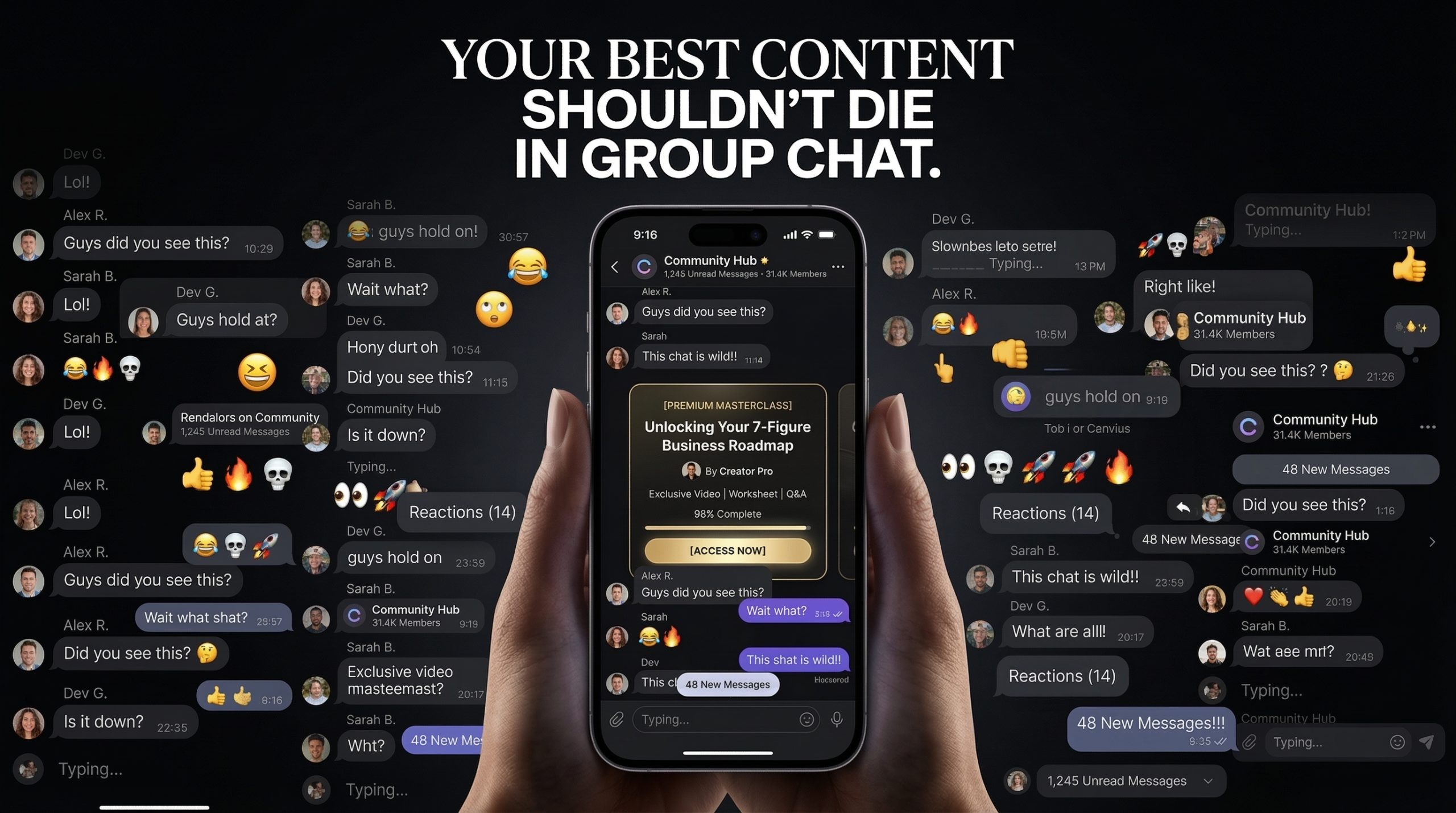
Forcing busy executives into a course portal is a death sentence for engagement. Traditional online courses often have completion rates as low as 5-15% for free content and 15-40% for paid, according to online learning statistics. This is largely due to the friction of requiring users to log into yet another platform. The power of meeting your audience where they already live, specifically on messaging apps like WhatsApp and Telegram, is transformative for B2B challenges.
CommuniPass enables participants to choose their preferred platform, eliminating friction and significantly boosting engagement. WhatsApp, for instance, boasts over 3 billion monthly active users and 98% open rates for businesses, according to YCloud. This omnichannel delivery is the secret weapon for B2B challenges in 2026, leading to completion rates like Sarah’s 68% compared to the mere 8% she saw with portal-based courses.
- Zero Friction: No logins, no forgotten passwords, content delivered directly to daily-used apps.
- High Engagement: Messaging apps have significantly higher open and response rates than email or LMS platforms.
- Personal Connection: Direct messaging fosters a more personal and immediate connection with the instructor.
- Ubiquitous Access: Professionals are already on these platforms for personal and professional communication.

The 7-Day Content Roadmap: What a High-Converting LinkedIn Challenge Looks Like
A high-converting 7-day LinkedIn challenge follows a structured content roadmap designed to build momentum and deliver tangible results. Each day focuses on a specific objective, culminating in a natural transition to a high-ticket offer. The content should be delivered in bite-sized pieces, typically a 2-minute video followed by one actionable task.
This structure balances education with immediate action, maintaining high engagement. LinkedIn’s algorithm in 2026 prioritizes thought leadership, consistent quality, meaningful conversations, and short-form video, making this format ideal for the platform.
- Day 1-2: The Quick Win. Provide immediate value that proves your methodology works. This builds initial trust and excitement. Example: “Optimize your LinkedIn headline for 3x more profile views.”
- Day 3-4: The Methodology. Teach a core piece of your unique framework in digestible chunks. Focus on the “how” behind the quick wins. Example: “The 3-step content strategy to attract ideal clients.”
- Day 5-6: The Obstacle. Address the biggest barrier to transformation your audience faces, positioning your premium offer as the solution. Example: “Overcoming imposter syndrome to post consistently.”
- Day 7: The Pitch. Naturally transition to your high-ticket offer, framing it as the logical next step for those who want deeper, more personalized results. Example: “Scaling your authority: The 1-on-1 path to LinkedIn mastery.”
The Upsell Architecture: How to Transition from $49 Challenge to $1,200 Program Without Feeling Salesy
The 7-day sprint naturally qualifies participants for high-ticket offers because they’ve already experienced your value and built trust. High-ticket offers, typically $1,000+, generate 5-50 times more revenue per 1,000 checkout views than low-ticket items, according to the Spiffy 2026 Creator Trends Report. The challenge creates an “earned authority” where you’ve delivered wins, and participants genuinely want more.
The invitation framework positions your premium program as the next logical step, not a pushy sale. Timing the pitch on Day 7, when trust and momentum are at their peak, is crucial. This aligns with best practices in B2B, where personalized offers can improve calls to action by over 200%, as highlighted by Martal Group.
- Built-in Qualification: Participants who complete the challenge are demonstrably committed and value your expertise.
- Results-Driven Trust: The challenge delivers tangible wins, making the upsell a natural extension of proven success.
- Timing is Everything: Pitching after a week of consistent value delivery maximizes receptiveness.
- Solving the “Next Problem”: The high-ticket offer addresses the deeper, more complex challenges that the 7-day challenge only began to solve.

Conclusion: Stop Selling Audits, Start Selling Transformations Through Challenges
The shift from hourly consulting to scalable transformation delivery is paramount for experts in 2026. The Sprint-to-Premium model offers a proven and repeatable path from $500 audits to $28K cohorts, outperforming traditional courses or one-time services. This approach leverages high-engagement, short-form challenges delivered through omnichannel platforms like CommuniPass to build deep trust and qualify participants for high-ticket coaching.
By focusing on rapid value delivery and seamless upsells, experts can stop trading time for money and start building a truly scalable business. The path to monetizing expertise in the AI era demands interactive experiences and outcomes, not just information.
Key Takeaways
- One-time audits and self-paced courses often lead to income ceilings and low engagement.
- 7-day challenges are the “Goldilocks Zone” for B2B, balancing commitment with results.
- Omnichannel delivery via CommuniPass (WhatsApp/Telegram) significantly boosts completion rates.
- A structured 7-day content roadmap builds trust and positions high-ticket offers naturally.
- The Sprint-to-Premium model creates a seamless funnel from low-ticket entry to high-ticket conversion.
- Scaling expertise requires shifting from transactional services to transformative, automated experiences.
Ready to Scale Your Expertise Beyond 1-on-1 Audits? Stop trading your life for $500 sessions. With CommuniPass, you can launch high-engagement 7-day challenges delivered natively to WhatsApp or Telegram, build massive trust, and fill your high-ticket programs on autopilot. Build Your 7-Day Challenge with CommuniPass Today.
Frequently Asked Questions
How much should I charge for a 7-day LinkedIn challenge?
A $49 entry point is ideal for a 7-day LinkedIn challenge, as it filters for serious participants while remaining accessible. This lower barrier, combined with high completion rates, creates the perfect setup for $1,200+ upsells, making the total revenue per participant much higher than a single high-ticket sale.
Why is 7 days better than a 30-day challenge?
Seven days is better than a 30-day challenge due to its significantly higher completion rates, often exceeding 60%, compared to the lower rates of longer programs. This shorter timeframe aligns with the commitment capacity of busy B2B professionals, creating urgency and momentum that longer programs struggle to sustain.
What is CommuniPass and why does it matter for challenge completion rates?
CommuniPass is an omnichannel delivery platform that sends challenge content directly to participants’ preferred messaging apps, such as WhatsApp or Telegram. This elimination of friction, by avoiding course portals and logins, is why experts like Sarah achieve completion rates of 68% compared to the 8% seen with traditional course platforms.
How do I get 150 people to join my first challenge?
To get 150 people to join your first challenge, leverage organic LinkedIn promotion strategies, engage your existing connections, create urgency through limited cohort sizes, and utilize social proof. Even with 500+ LinkedIn connections, a well-executed launch strategy can attract 50-100 participants. Explore challenge funnel that delivers.
What’s the difference between the Sprint-to-Premium model and selling a course?
The Sprint-to-Premium model is a 7-day interactive challenge with daily tasks and community engagement, specifically designed as a funnel to high-ticket offers. In contrast, courses are typically passive content consumption with no built-in upsell architecture or completion incentives, leading to lower engagement and conversions.
How do I pitch my high-ticket program without being pushy?
Pitching your high-ticket program without being pushy involves an invitation framework where, by Day 7, participants have seen tangible results and built trust through consistent wins. The pitch then becomes a natural next step for those seeking deeper transformation, rather than a hard sell.
Can I really make $28K from one 7-day challenge?
Yes, making $28K from one 7-day challenge is achievable, as demonstrated by Sarah’s math: 150 participants at $49 yields $7,350, plus 18 high-ticket conversions at $1,200 each adds $21,600. This requires both a solid challenge experience and a compelling high-ticket offer, along with effective execution and an adequate audience size. Explore high-ticket sales funnel 7-day challenge.
What if I don’t have a high-ticket program to upsell to?
If you don’t have a high-ticket program, you can design one that naturally extends the challenge’s transformation by identifying participants’ most pressing needs. The challenge itself helps clarify these needs, making it easier to create a relevant premium program such as 1-on-1 coaching or a small group intensive.
Do I need to be available 24/7 during the challenge?
No, you do not need to be available 24/7 during the challenge because CommuniPass automates daily content delivery. The challenge structure, featuring 2-minute videos and one task, is designed for minimal live interaction, allowing you to focus on high-value engagement and identifying upsell candidates while AI and community provide support.
How is this different from the $15K MRR model I’ve heard about?
This Sprint-to-Premium model differs from the $15K MRR model by focusing on high-ticket one-time sales, typically $1,200 or more, rather than monthly recurring revenue. While both are valid, the Sprint-to-Premium approach generates larger immediate cash injections and is particularly effective for consultants selling transformation rather than ongoing access. Explore launch a paid challenge.
Key Terms Glossary
Sprint-to-Premium Model: A strategy leveraging short, intensive challenges to build trust and convert participants into high-ticket clients.
Audit Trap: The cycle where consultants trade hours for dollars through one-time services, limiting scalability and income.
Omnichannel Delivery: Providing content and interaction across multiple platforms, such as messaging apps and email, to meet users where they are. Explore high completion funnels.
High-Ticket Offer: A premium coaching or consulting program priced at $1,000 or more, focused on deep transformation and significant results.
CommuniPass: An AI-powered platform for delivering interactive challenges and content directly to messaging apps like WhatsApp and Telegram.
Earned Authority: Credibility and trust established by consistently delivering value and results to an audience over time.
Completion Rate: The percentage of participants who successfully finish a course or challenge, significantly higher with interactive and messaging-based delivery.
LinkedIn Authority Challenge: A specific 7-day program designed to help professionals establish expertise and attract clients on LinkedIn.